|
现代企业每天都在处理大量数据,分散在不同格式的文档、视频、邮件、聊天记录和电子表格中。然而,真正的挑战不仅是存储这些信息,而是要让它们易于访问并转化为可用的知识。传统搜索方案存在几大痛点: 只能精确匹配关键字,无法应对复杂查询需求。 缺乏语义理解,难以深入挖掘信息。 难以兼容多种文件格式,信息检索不全面。 无法从用户交互中学习,自我优化能力不足。
企业亟需一个能够打破格式限制、理解上下文并持续智能化的解决方案,以满足不断变化的业务需求。 
检索增强生成 (RAG) 正在彻底改变企业知识库的管理方式。作为组织的“智能内存”,RAG 提供了以下关键优势: 理解上下文:RAG 不仅限于简单的关键字匹配,还能理解问题背后的真实含义,提升了问答的准确性。 处理多种格式:RAG 能够处理各种类型的数据,无论是 PDF、视频,还是电子邮件,都能进行智能解析。 保持最新:与传统 AI 模型不同,RAG 能够随时引用最新数据,确保信息的实时性和相关性。 保持准确性:通过直接引用实际文档中的内容,RAG 能够避免虚构内容,提供更可信的答案。 这些能力使 RAG 成为企业应对数据复杂性、实现智能化知识管理的理想解决方案。 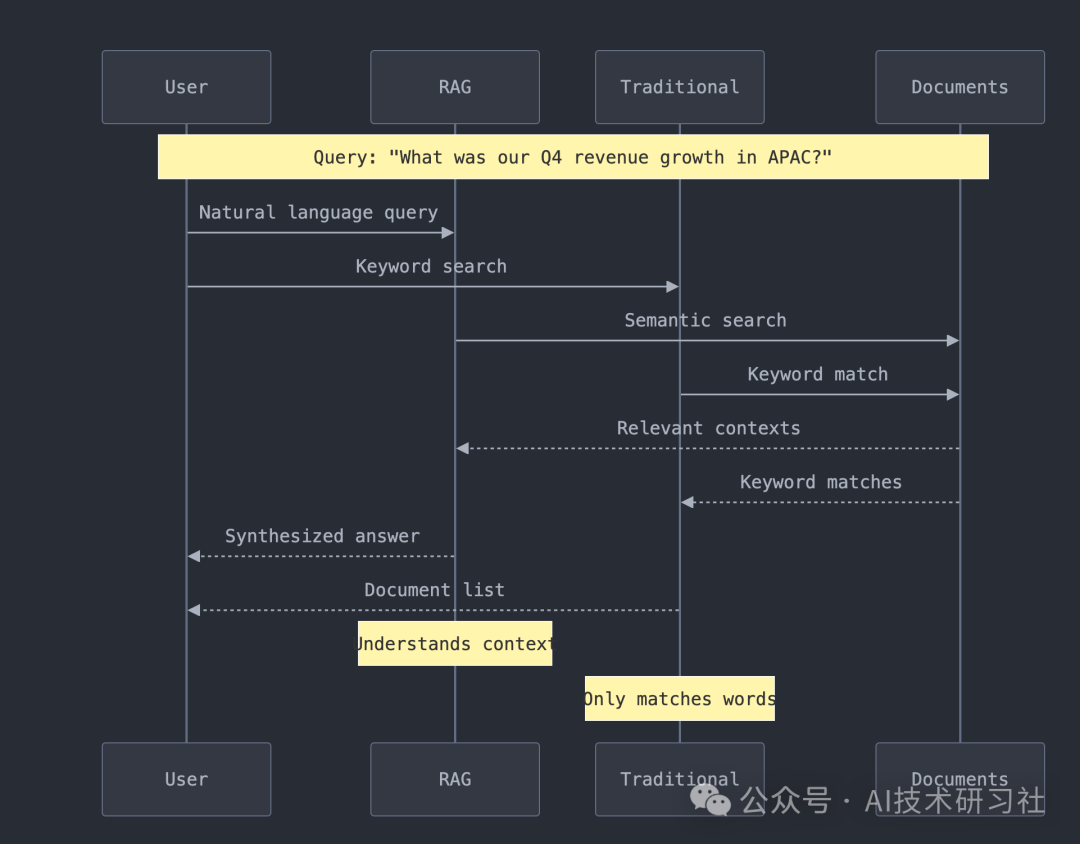
接下来,创建一个全面的 RAG 管道。管道提供多种功能: #ExampleusageofourRAGpipelinefromrag_pipelineimportRAGPipeline,FileConfig#Initializewithsmartdefaultspipeline=RAGPipeline(persist_directory="./chroma_db",collection_name="enterprise_docs",config=FileConfig(chunk_size=1000,chunk_overlap=200,whisper_model_size="base"))#Processentiredirectoriesofmixedcontentresult=pipeline.process_directory("./company_data")多种文件格式支持
管道可处理文件格式广泛,包括文档(如 .pdf, .docx),媒体文件(如 .mp3, .mp4),和通信格式(如 .eml, .html)等。
supported_types=[#Documents'.pdf','.docx','.pptx','.xlsx','.txt',#Media'.mp3','.wav','.mp4','.avi',#Communications'.eml','.html','.md'] 智能处理
智能分块:优化上下文理解 自动元数据提取 音频/视频文件转录 向量嵌入生成:支持高效内容检索 高效存储和检索
提供结构化的存储和快速的内容检索,以确保数据的高效利用和易访问性。 #Examplequeryresults=pipeline.db_manager.query(collection_name="enterprise_docs",query_texts=["WhatwereourkeyachievementsinQ4?"],n_results=3) 

接下来,技术要求和先决条件,环境准备:1. Python Environment1.Python环境2.核心依赖 pipinstall-rrequirements.txt # Core dependencieschromadb>=0.4.0langchain>=0.1.0pandas>=1.5.0numpy>=1.24.0sentence-transformers>=2.2.0
# Document processingpypdf>=3.0.0python-docx>=0.8.11openpyxl>=3.1.0python-pptx>=0.6.21beautifulsoup4>=4.12.0markdown>=3.4.0lxml>=4.9.0
# Media processingopenai-whisper>=20231117moviepy>=1.0.3pydub>=0.25.1torch>=2.0.0
# Optional but recommendedtqdm>=4.65.0python-magic>=0.4.27pyyaml>=6.0.0
所有代码均已完整记录并遵循最佳实践: defprocess_file(self,file_path:str)->List[Document]:""" rocessasinglefileandreturnchunkswithmetadata.Args:file_path(str) rocessasinglefileandreturnchunkswithmetadata.Args:file_path(str) athtothefiletoprocessReturns athtothefiletoprocessReturns ist[Document]istofprocesseddocumentchunksRaises:ValueError:Iffiletypeisnotsupported""" ist[Document]istofprocesseddocumentchunksRaises:ValueError:Iffiletypeisnotsupported""" 了解 RAG 架构:现代文档智能的构建块
RAG 系统的组件1. 文档处理流程class DocumentProcessor:def __init__(self, config: FileConfig):self.config = configself.text_splitter = RecursiveCharacterTextSplitter(chunk_size=config.chunk_size,chunk_overlap=config.chunk_overlap)
def process_file(self, file_path: str) -> List[LangchainDocument]:"""rocess a single file into searchable chunks"""# Extract text based on file typetext = self._extract_text(file_path)# Split into manageable chunkschunks = self.text_splitter.split_text(text)# Add metadata for better retrievalreturn [LangchainDocument(page_content=chunk,metadata={"source": file_path,"chunk_index": i,"processed_date": datetime.now().isoformat()})for i, chunk in enumerate(chunks)]
2.向量存储

以下是使用 ChromaDB 实现这一点: class ChromaDBManager:def __init__(self, persist_directory: str):self.client = chromadb.PersistentClient(path=persist_directory)self.embedding_function = embedding_functions.DefaultEmbeddingFunction()
def add_documents(self, collection_name: str, documents: List[LangchainDocument]):"""Store documents with their vector embeddings"""collection = self.get_or_create_collection(collection_name)# Prepare documents for storagedocs = [doc.page_content for doc in documents]metadatas = [doc.metadata for doc in documents]ids = [f"{doc.metadata['file_hash']}_{doc.metadata['chunk_index']}" for doc in documents]
# Store in ChromaDBcollection.add(documents=docs,metadatas=metadatas,ids=ids)
3. 检索机制将问题转换到相同的向量空间,检索相关文档块。
defquery_database(self,query:str,n_results:int=3)->Dict:"""Executeasemanticsearchquery"""try:results=self.collection.query(query_texts=[query],n_results=n_results)returnresultsexceptExceptionase:self.logger.error(f"Errorqueryingdatabase:{str(e)}")returnNone4. 查询处理这是将用户问题转化为可操作搜索的地方: 
# Traditional Searchresults = database.find({"$text": {"$search": "revenue growth 2023"}})
# RAG Searchresults = rag_pipeline.query("How did our revenue grow in 2023 compared to previous years?")

数据流处理,媒体处理:class MediaProcessor:def __init__(self, config: FileConfig):self.whisper_model = whisper.load_model(config.whisper_model_size,device=config.device)
def process_media(self, file_path: str) -> str:"""rocess audio and video files"""file_ext = Path(file_path).suffix.lower()# Handle video filesif file_ext in ['.mp4', '.avi', '.mov']:audio_path = self.extract_audio(file_path)return self.transcribe_audio(audio_path)# Handle audio fileselif file_ext in ['.mp3', '.wav', '.m4a']:return self.transcribe_audio(file_path)
内容比较多,未完,上面是部分代码,整个代码结构如下:

结论:构建企业级 RAG 管道就像构建一个智能图书馆,它不仅可以存储文档,还可以智能地理解和检索它们。通过本文,我们介绍了如何构建一个系统。
|